Please wait, while our marmots are preparing the hot chocolate…
# @chunk: chunks/title.md
# @chunk: chunks/objectives.md
## Programmation Web Avancée {var-cours-n} : {#plan overview}
- Introduction globale au cours
- Applications Web : vue d'ensemble {webapp}
- Pourquoi ce cours? {why}
- Les technologies prévue en PWA {techs}
- Plus… {more}
# @copy:#plan
# Avertissement / Disclaimer {no-print}
# Avant de commencer {no-print}
## Sondage ... {libyli no-print}
- Java?
- Java Servlets?
- Web pages using PHP? // what framework?
- HTML?
- CSS?
- JavaScript ?
- Système de gestion de version ?
- Git ?
- GitHub, Gitlab, bitbucket ?
- Design patterns ? // heard of it, master it?
- Laptop perso pour les TP etc ?
## Logistique (prévue)
- Cours et travail personnel
- cours+exercices ~20h, TP/pratique ~10h // theoretical volume
- **projet**, avec quelques suivis brefs
- mixed sessions: courss/demo/exercices/TP {slide}
- classe inversée {slide}
- Planning indicatif: 3h Vendredi matin {slide}
- Évaluation {slide}
- « théoriques » : QCM + questions ouvertes et exercices
- « pratique », projet : rapport, présentation, et démo
- Règles du jeux {slide}
- soyez actifs, participez
- posez des questions
- interrompez quand nécessaire
- Proposez des sujets de cours et des idées de projet {slide} // we cannot do everything, ...
- Référence du cours [http://learn.heeere.com/2017-pwa-7c99](http://learn.heeere.com/2017-pwa-7c99) {slide}
## Classe inversée {libyli #classeinv}
- Constat
- cours « encyclopédiques » ⇒ baisse d'attention
- liberté ⇒ travail à la dernière minute ⇒ seul avec ses problèmes ⇒ échec // parfois aussi insuffisant
- Principe de la classe inversée
- acquisition de connaissances avant le cours
- clarification et approfondissement en cours
- Travail avant le cours
- regarder une vidéo, lire une partie de cours, ... // chacun à son rythme
- faire des exercices
- prendre des notes, noter vos interrogations
- En cours
- questions de votre part
- discussions
- QCM, exercices
# @copy:#plan: %+class:inred: .webapp
## Web Application?
- What does the wikipedia website do when you do a search?
- type `wikipedia.com` in the address bar
- type “higggs” (3 g) in the search box and click on the `→` button
- in response, you get
https://en.wikipedia.org/wiki/Special:Search?search=higggs&go=Go&searchToken=af3… {slide}
- C: {comment}
- those who never did web programming, imagine what a program should do to achieve what you observe
- those who did, comment and explain to us
- C: {comment}
- the goal is make a figure on the board (and take a picture of it)
## User, Browser (Client), Server
- The Browser (firefox, chrome, internet explorer, edge, safari, ...) {libyli}
- displays pages (HTML+CSS+…) // SVG, images, videos, webgl, …
- executes scripts (JavaScript)
- sends requests to the server
- user actions (links, forms, …) // references that are contained in the HTML
- automated scripts (automatic refresh, etc)
- The Server {slide libyli}
- receives requests
- executes code depending on the requests
- may send back static resources (fixed pages, images, …) // in the past, only this
- loads and updates data // from a database
- generates response pages
- sends pages to the client
# @copy:#plan: %+class:inred: .why
## Why Learning to Build Web Apps? {libyli}
- As a web app user
- understand how things work behind the scene
- feel empowered to build things
- understand privacy and security implications
- As a software engineer
- more and more applications are web based // fewer and fewer desktop applications
- convergence of mobile and web
- As a scientist (researcher or R&D engineer)
- generate ad hoc visualizations of results … … …
- do attractive visualization for communications
# @copy:#plan: %+class:inred: .techs
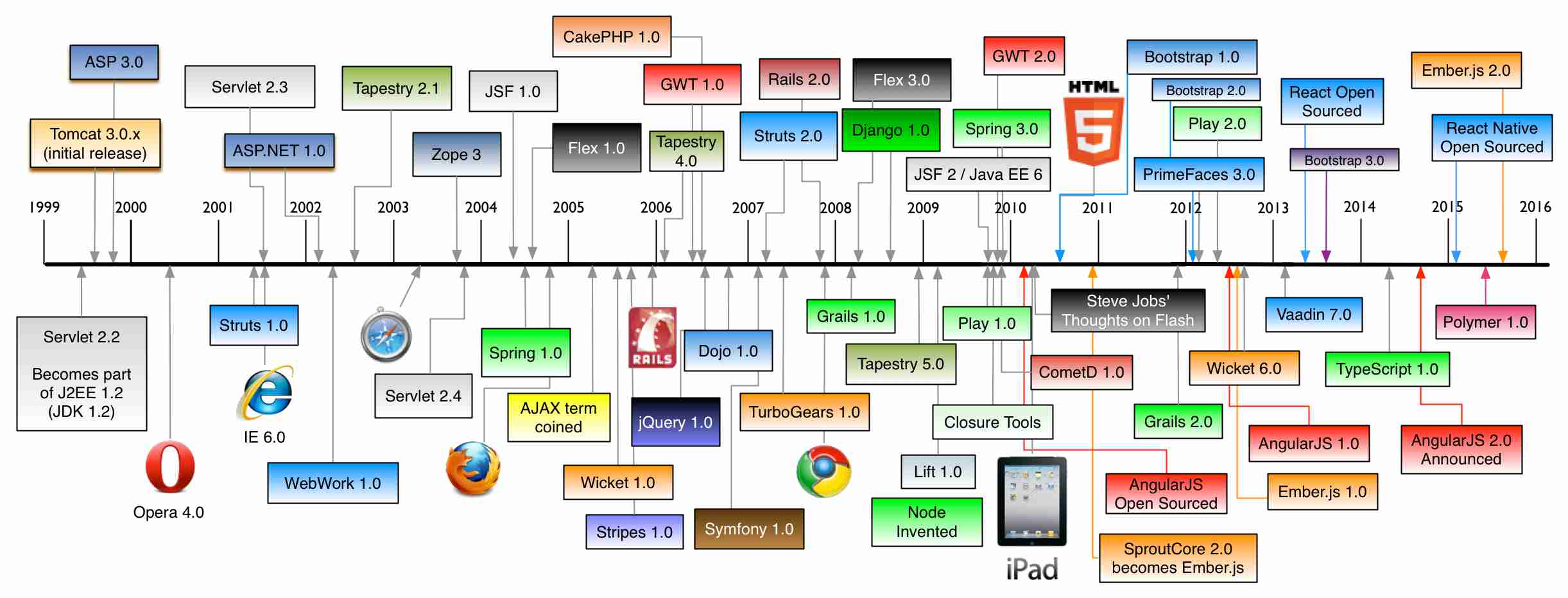
## Technologies From Today and Yesterday
## Potential Technologies in this course
- Dans ce cours de PWA {libyli}
- coté server, principalement du Java
- coté client, les bases techs (HTML, CSS, javascript)
- coté client, framework (Angular, React, Vue)
- JEE : Java Entreprise Edition {slide dense} // J2EE before renaming
- a standard for Java servers
- Java: portability, security, standardization
- JEE web container {slide}
- runtime environment providing services
- portability between containers
- JEE platform specification {slide}
- tens of individual specifications (JSR) // Java Specification Requests, http://www.oracle.com/technetwork/java/javaee/tech/index.html
- servlets, JSP, JPA, … // some we'll see
- Spring (Pivotal) {slide} // VMware -> joint venture with GE : pivotal
- additional framework around JEE
- Java and Groovy {slide} // G2One bought by SpringSource
- not a standard ⇒ sometimes faster advances {slide}
- JEE and Spring {slide}
- both huge // a lot of things
- evolve in parallel and interact positively
# @copy:#plan: %+class:inred: .more
## Learning to Learn (in general) {libyli}
- Work regularly (not a big rush before the deadline)
- repeat exercises
- practice (don't just re-read things)
- Be extremely focused
- limit interruptions
- work for fixed-duration slots (e.g., 25 minutes)
- … but make real and regular breaks
- stretch or have a walk
- practice sport
- sleep well
## Succeeding in this Course {libyli}
- Be pro-active in lessons and practical sessions
- Embrace the proposed technologies
- Bring your own objectives and ideas
- Look and ask for complement (me, other students, online, ...)
- Practice!
- make room on your computer to install things
- install the required software
- practice regularly
# Idée de Projets ?
Accent sur certaines Technologies ?
# Commencez à penser au
Projet et aux Équipes (de 3)
## Key Points {key deck-status-fake-end}
- Course Objectives
- understanding web apps principles and evolution
- mastering some technologies
- “full-stack”: both client and server side techs
- Logistics
- sessions de (cours + demo + TP)
- suivi de projet
- exam + qcm + projet
- Learn to learn efficiently!
- Course reference :
http://learn.heeere.com/2017-pwa-7c99/
# 6-minute break … …
# @copy:#classeinv
## Pour la prochaine fois (mercredi) {libyli}
- Au sujet de CSS
- Comprendre les sélecteurs (slides « cours-02 »)
- Comprendre la notion de spécificité
- Comprendre le box-model (slides « cours-02 »)
- Prendre des notes
- Arriver avec des questions
- Lire (en ignorant possiblement les aspects parallèles)
https://blog.mozfr.org/post/2017/09/Au-coeur-moteur-CSS-super-rapide-Quantum-CSS-stylo
/ − will be replaced by the author − will be replaced by the title